We use cookies to make your experience better. To comply with the new e-Privacy directive, we need to ask for your consent to set the cookies. Learn more.

Batteries
How to choose the right battery: nominal vs. usable capacity
Every battery in this category displays its nominal capacity in kWh (voltage × amp-hours), making products easy to compare. However, the energy you can actually use depends on the battery's recommended Depth of Discharge (DoD). That is why every product page also shows a "Usable in practice" value – the energy you can use per cycle without significantly reducing battery life.
(Absorbent Glass Mat) is a sealed, maintenance-free lead-acid battery with very low internal resistance. It handles high discharge currents well (inverters, bow thrusters, winches) and is the most affordable option. For good service life, about 50% of the capacity should be used per cycle. A 2.64 kWh AGM battery realistically provides about 1.3 kWh of usable energy.
uses improved plates and additives that greatly reduce sulfation. It supports frequent discharges of around 80% and even occasional full discharges. It is the ideal choice when lithium is outside the budget but the battery will be deeply cycled on a regular basis.
batteries use a gelled electrolyte. Compared to AGM they offer longer cycle life and better resistance to repeated cycling, while the same 50% DoD is recommended for maximum lifespan. They are well suited to small solar systems with daily cycling.
batteries use a carbon composite on the negative plate, greatly reducing sulfation, the main cause of degradation in lead batteries. They support around 60% DoD for over 1000 cycles and perform very well under partial-state-of-charge operation. They bridge the gap between conventional lead-acid and LiFePO4.
(Lithium Iron Phosphate) is the most popular lithium chemistry for solar and off-grid systems. Around 80% of the capacity can be used every cycle (with occasional full discharges), delivering roughly 3000 cycles while weighing about half as much as an equivalent lead battery. Although the initial cost is higher, the lifetime cost per delivered kWh is usually the lowest. Victron Smart batteries require an external BMS.
Quick comparison
| Chemistry | Recommended DoD | Usable from 1 kWh nominal | Typical cycles | Best for |
|---|---|---|---|---|
| AGM Deep Cycle | ~50% | ~0.5 kWh | ~600 at 50% DoD | High currents, low budget, occasional use |
| AGM Super Cycle | ~80% | ~0.8 kWh | ≥700 at 60% / ≥300 at 100% | Frequent deep discharges |
| Gel Deep Cycle | ~50% | ~0.5 kWh | ~750 at 50% | Small solar systems, daily cycling |
| Lead Carbon | ~60% | ~0.6 kWh | >1000 at 60% | Off-grid, partial-state-of-charge |
| LiFePO4 | ~80% (100% occasionally) | ~0.8–1 kWh | ~3000 at 80% | Heavy cycling, low weight, lowest lifetime cost |
Practical sizing rule
Always size your battery by usable kWh, not nominal kWh. For example, a nightly consumption of 1 kWh requires either an AGM battery of around 2.6 kWh or a LiFePO4 battery of around 1.28 kWh. Although their nominal capacities differ greatly, both provide the same usable energy. The LiFePO4 battery will typically deliver about five times more cycles while weighing roughly half as much. If you are unsure which battery to choose, contact us and we will recommend the right solution.
-
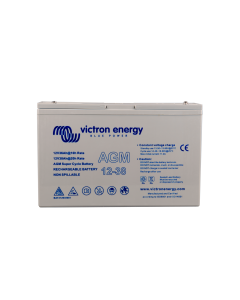
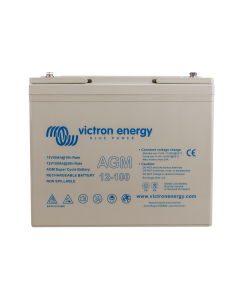 VICTRON ENERGY - BAT412110081 - AGM Super Cycle Battery 1.2kWh / 12V / 100Ah (M6)Lei 1,451.00 Lei 1,199.17
 -
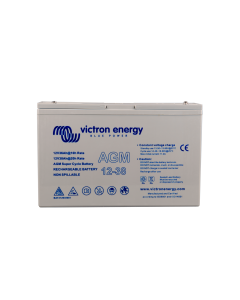
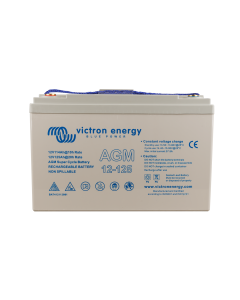 VICTRON ENERGY - BAT412112081 - AGM Super Cycle Battery 1.5kWh / 12V / 125Ah (M8)Lei 1,841.00 Lei 1,521.49
 -
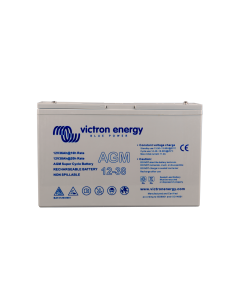
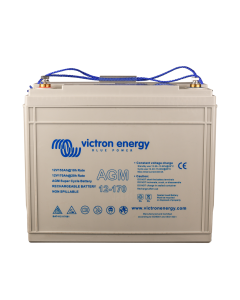 VICTRON ENERGY - BAT412117081 - AGM Super Cycle Battery 2.04kWh / 12V / 170Ah (M8)Lei 2,320.00 Lei 1,917.36
 -
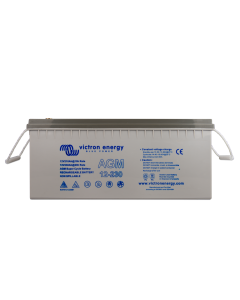 VICTRON ENERGY - BAT412123081 - AGM Super Cycle Battery 2.76kWh / 12V / 230Ah (M8)Lei 3,072.00 Lei 2,538.84